Facilitating circular transformation processes since 2012
Moving from theory to implementation of the Circular Economy
with the Circular Sprint
EcoCanvas
🗹 Design future-proof solutions and business models in an agile, visual and collaborative way, in just 4 working sessions.
🗹 Facilitate, successfully, real strategic transformation processes towards the Circular Economy.
🗹 Turn vulnerabilities into opportunities to become more competitive, profitable, resilient and circular.
The challenges organizations face today
An ordinary day at the office…
We want to join the Circular Economy, but we lack knowledge, methods, and practical tools.


We have problems with resource supply and waste. We don’t know where or how to start and prioritize.
We lack an updated strategic vision of the transformation potential of the circular economy to refocus projects.


We have an idea for a circular product/service, but we can’t organize the steps to move forward and validate it.
Progressing towards a Circular model is complex
The problem: "We want to... but not sure how"
Companies, start-ups and institutions want to move towards the circular economy.
They have realised that the linear model has no future and that, if they wish to remain relevant in the market, stay competitive and be able to generate real value, they must transition to circular business models.
However, this transition to the Circular Economy is often a difficult, complex and chaotic process because it requires tackling multiple interconnected issues simultaneously. Issues that influence not only environmental management but also the very essence and mission of the company.
"I’ve got a supply chain headache...
Can I get a prescription for 4 boxes
of Circular Economy pills?"
Concerned and confused client
It doesn’t work like that.
If only we could simply take a few ‘circularising’ pills to solve all the business ailments caused by ‘linearity’.
So the million-dollar question is… How can we actually achieve this?
The first and most relevant methodology for designing circular business models
You need an agile, efficient and effective method.
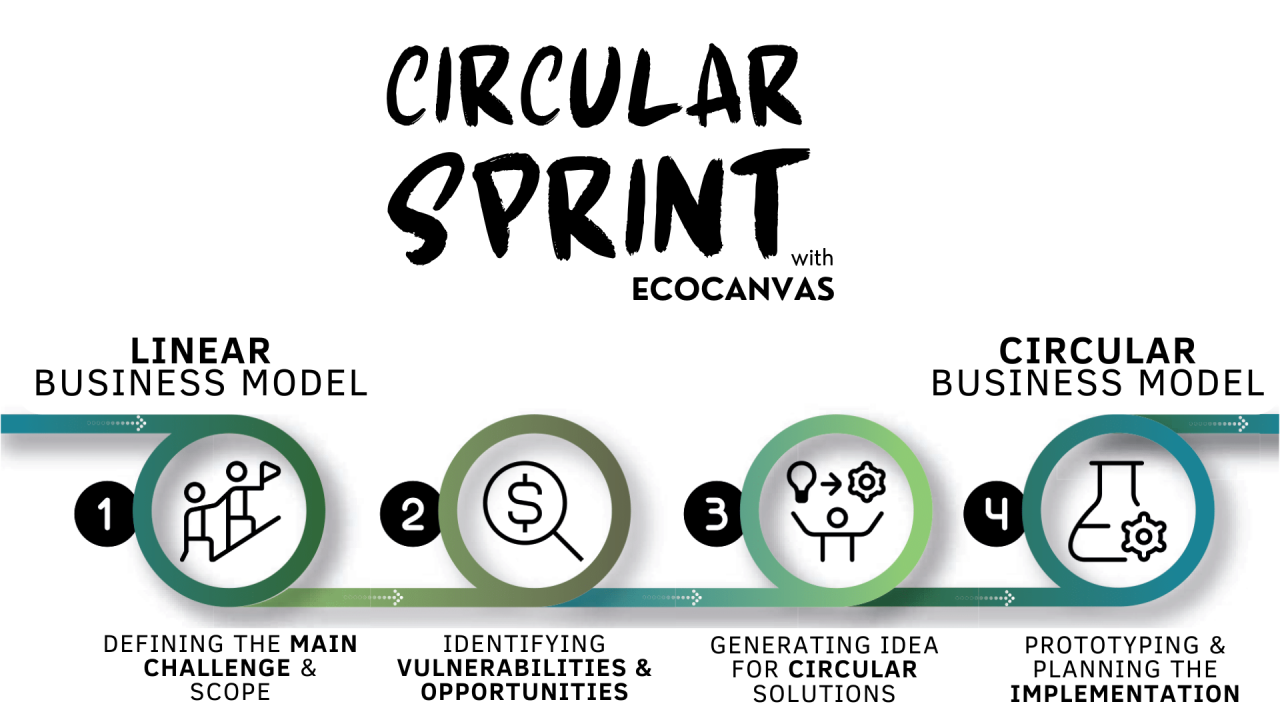
You need a Circular Sprint EcoCanvas
The EcoCanvas methodology is based on the step-by-step construction of a prototype for a circular business model.
The visual templates and methodological guidelines, the result of more than 14 years of successful work with companies, help you organize priorities, generate new ideas with hypotheses to validate, and foster essential conversations for the maturation of the circular solution or business idea.
Reasons to trust
Why choosing EcoCanvas?

Agile
High impact in a short time: 80% impact with 20% effort
Ecocanvas is not about a classic consulting process, but rather a SPRINT, a fast and high-impact process. We are talking about obtaining significant results in 4 work sessions to generate high-impact projects in less than 3 months.

Structured
The process is key:
step by step you reach hidden places
If it were easy to reach the destination, everyone would be transitioning towards the Circular Economy; if this is not the case, it is because there are many hidden barriers. Articulated and structured processes help precisely in advancing from point A to point B through a "path" C that was not initially identified.

Collaborative
Aligning teams and
co-creating is the fundamental
principle
It is surprising to see how misaligned teams are when we start transformation processes. Each person has a biased vision of the company's challenges, and working side by side helps prioritize the most important aspects and build new business realities together.

Visual
The power of visuals:
a picture is worth a thousand words
To reduce complexity and be able to manage it, it is necessary to use visual tools that help understand the interactions of the value chain. Thanks to the Ecocanvas visual templates, we make the difficult easy, we make conversations more inclusive, and we focus on what is truly important.
Tangible results from the first session
How do we help you? In 4 steps

Day 1: Define the priority challenges, align the teams, and select the area of intervention.
Immediate results
- Strategic clarity
- Shared vision
- Prioritization of the scope

Day 2: Analyze the value chain, turn vulnerabilities into opportunities.
Immediate results
- Resource optimization
- Focus on key opportunities
- Innovation in processes

Day 3: Draw inspiration from circular strategies and devise innovative solutions.
Immediate results
- Collective creativity
- Tailored solutions
- Safe space to dare

Day 4: Define a prototype and create an action plan and validation for implementation.
Immediate results
- Concreteness, before action
- Validation, before action
- Minimize risks
"The real journey of discovery consists not in seeking new landscapes, but in having new eyes."
Marcel Proust (clearly referring to EcoCanvas 😊 )
Hundreds of companies and organisations around the world have placed their trust in us and continue to do so
Some of our clients we supported with Circular Sprint EcoCanvas













Achieving real impact
Some of our client's feedback

Elisabetta Pieragostini
Administrator at Da.Mi. S.R.L. · Italy
We started the Circular Sprint with the idea of finding a circular solution for ethylene-vinyl acetate (EVA) waste, which represents a major bottleneck in our production process. A few months later, we have gone from 0 to 40-50% recovered material, which is subsequently regenerated thanks to the collaboration with our suppliers. There is still a lot to improve, but we have embarked on a path.
For a long time, we have integrated a circular, "cradle to cradle" design approach. The Sprint took us further, helping us identify new areas for improvement, especially in the management of our production scrap. We discovered that these materials can not only be reused in our own products as we had been doing, but we can also manage them in a more sophisticated way towards a catalog of items created from this waste. New paths have opened up and we are excited to explore them.

Rossalyn Sapelli Zuñiga
Deputy General Manager at Sapelli Mobiliario · Peru

Jordi Tort
Deputy Mayor for Territorial Planning and Sustainable Economic Development · Gavà City Council · Spain
The synergy between the public and private sectors is key to the Circular Economy. Tools like the Circular Sprint allow designing effective strategies adapted to territorial contexts. Public administrations have the opportunity to lead change locally, involving the population and enabling real transformation mechanisms.
Very grateful for the Circular Sprint process, every moment has brought us important learnings thanks to the great work of the facilitators, and we will continue advancing with the fuse recovery project. To date, we have recovered more than 750 kilos of valuable raw material, but it doesn't end here; we want to continue being market leaders and this framework shows us the right direction.

Federico G. Burlando
Technical Director at Lerca S.C.A. · Argentina
EcoCanvas supported hundreds of companies and organisations worldwide
Highlighted success stories
The Sfridom Case by MCC, Italy
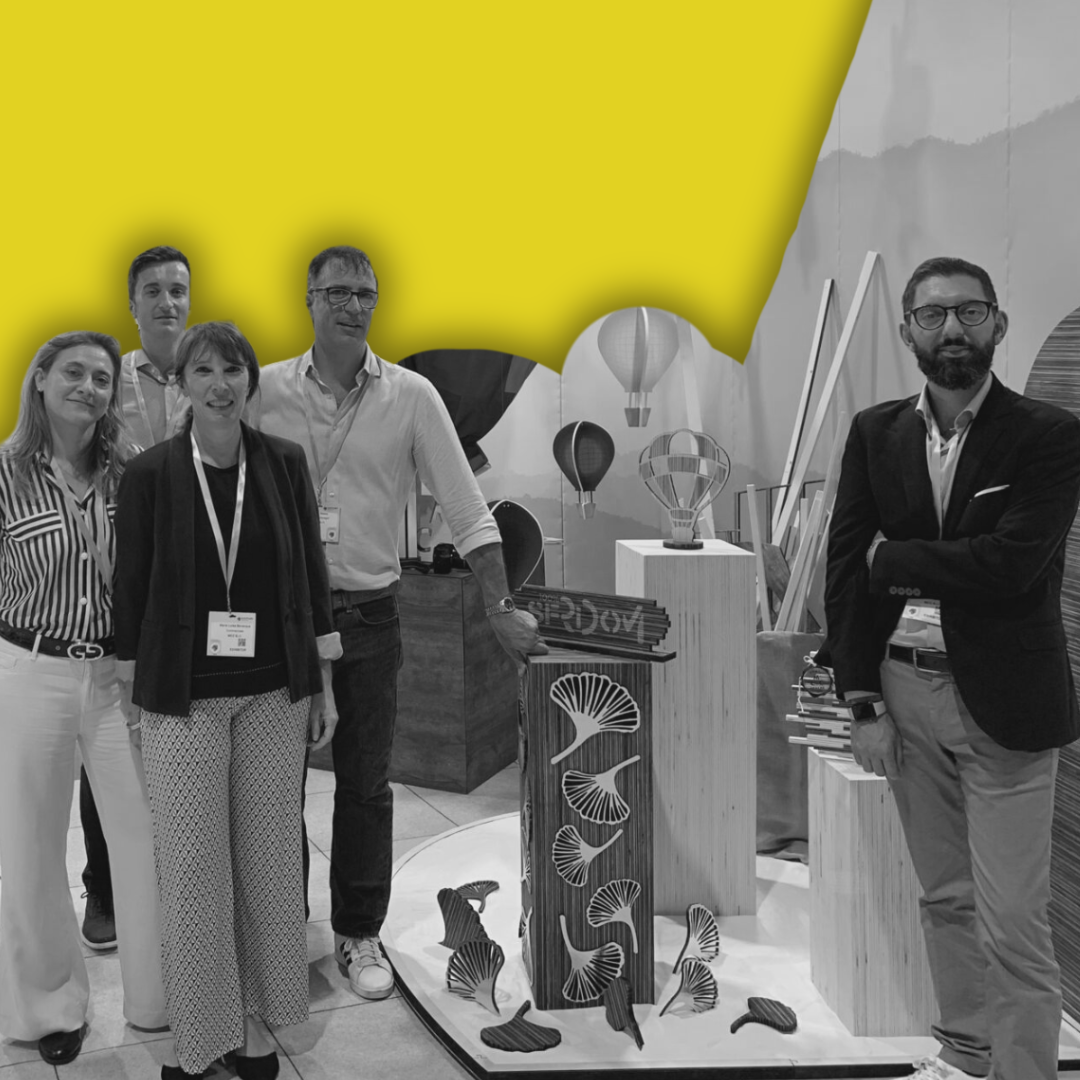
Regenerated panels,
up to 40% cheaper
One of the most emblematic success stories is that of the Italian SME MCC Italia, which developed an innovative solution for utilizing discarded pre-consumer panels during the Circular Sprint. Following the Sprint and several months of validation and lab testing, they found their path by launching SFRIDOM, a new brand of regenerated panels.

Reduction of waste and costs
Recovering value from the 1000 panels a year that were sent to the landfill and represented a cost.

40% cheaper than "virgin"
The new regenerated panel costs 40% less than a new one, allowing an increase in margin.

More attractive to the client
Presented at the 2021 Milan fair, it was received with great interest and orders from clients.
The Okorei Brewery Case, Italy

Beer made
from another "dough"
Okorei is dedicated to the artisanal production of beer in southern Italy. It has a strong connection with the territory and that is where the solution emerged from. During the Sprint, they initially detected the opportunity to incorporate leftover "stale" bread to replace the roasted barley input. After the Sprint and looking around, they found a neighboring company that has discarded defective pasta, and there was the match.
Reduction of waste and costs
Converting the waste of one (imperfect pasta) into the raw material of another (craft beer)
From 200 kilos to 2500 liters
Replacing barley malt and avoiding 1.3Kg CO2 equiv per batch: from 200 Kg of pasta to 2500 L of beer.
A story to tell
Incorporating circularity as a differentiating proposal in a saturated market. Very powerful storytelling.
The Reform Case, B Corp, Denmark

Solutions to reduce
losses and errors
Reform is a Danish company that offers designer kitchens, based in Copenhagen. Certified B corp and with Cradle2Cradle certified products, it leads a vision of sustainability in its sector.
After carrying out a Circular Sprint it has prototyped more than 20 solutions to further improve its operations.
Intelligent order management
25% reduction in order errors thanks to the prototyped solution.
Savings in logistics and emissions
Order failures entail major expenses in logistics and emissions to replace erroneous parts.
Less stress for everyone
Avoiding erroneous orders makes everyone happier: the clients, the brand image, and above all, the finance colleague.
The right moment is now
Ready to close the loop?
Get expert guidance on your Circular Sprint EcoCanvas.
Contact us today for personalized support and detailed insights.

